From Operating Intelligence · Brandon Chiazza · Silent Way Press · Summer 2026
Twelve operating principles for enterprises building AI that compounds value rather than capability. Short enough to quote in a board meeting. Substantive enough to hold the program accountable to them.
Enter your email and we'll send you the printable framework PDF — plus the occasional field note from how the Laws are showing up in real engagements. Unsubscribe any time.
We will never share your email. The framework PDF is free to share inside your organization.
Each Law is developed in depth in the book — and put to work in the companion artifacts (Self-Assessment, Charter, Diagnostic).
Models are the smallest part of enterprise AI advantage.
The Context Layer is the durable asset. Everything else depreciates.
A proof of concept shows that the technology can perform. A proof of value shows that the work improves.
Baseline before you build. A weak baseline is more useful than no baseline.
Hallucinations are a structural property of next-token prediction, not a bug to be patched.
A disclaimer is not a control boundary.
Bounded autonomy: every agent's permissions, reversibility, and escalation are first-class design decisions.
The evaluation harness is the precondition for everything else.
Three words for value: projected, realized, banked.
Every AI system needs a written rule under which it will be taken offline.
Authority should match accuracy.
Operating-model change is not the consequence of AI adoption. It is the price.
The Laws give you a portable framework for the next AI investment conversation. Short enough to quote in a board meeting, substantive enough to hold the program accountable to them.
The Laws name the operating disciplines that turn a working demo into a system that ships and survives — the evaluation harness, the context layer, bounded autonomy, the written shutdown rule.
The Laws define the structural controls that distinguish "we deployed AI" from "we govern AI" — control boundaries, baselines, source authority, the operating-model change that adoption actually requires.
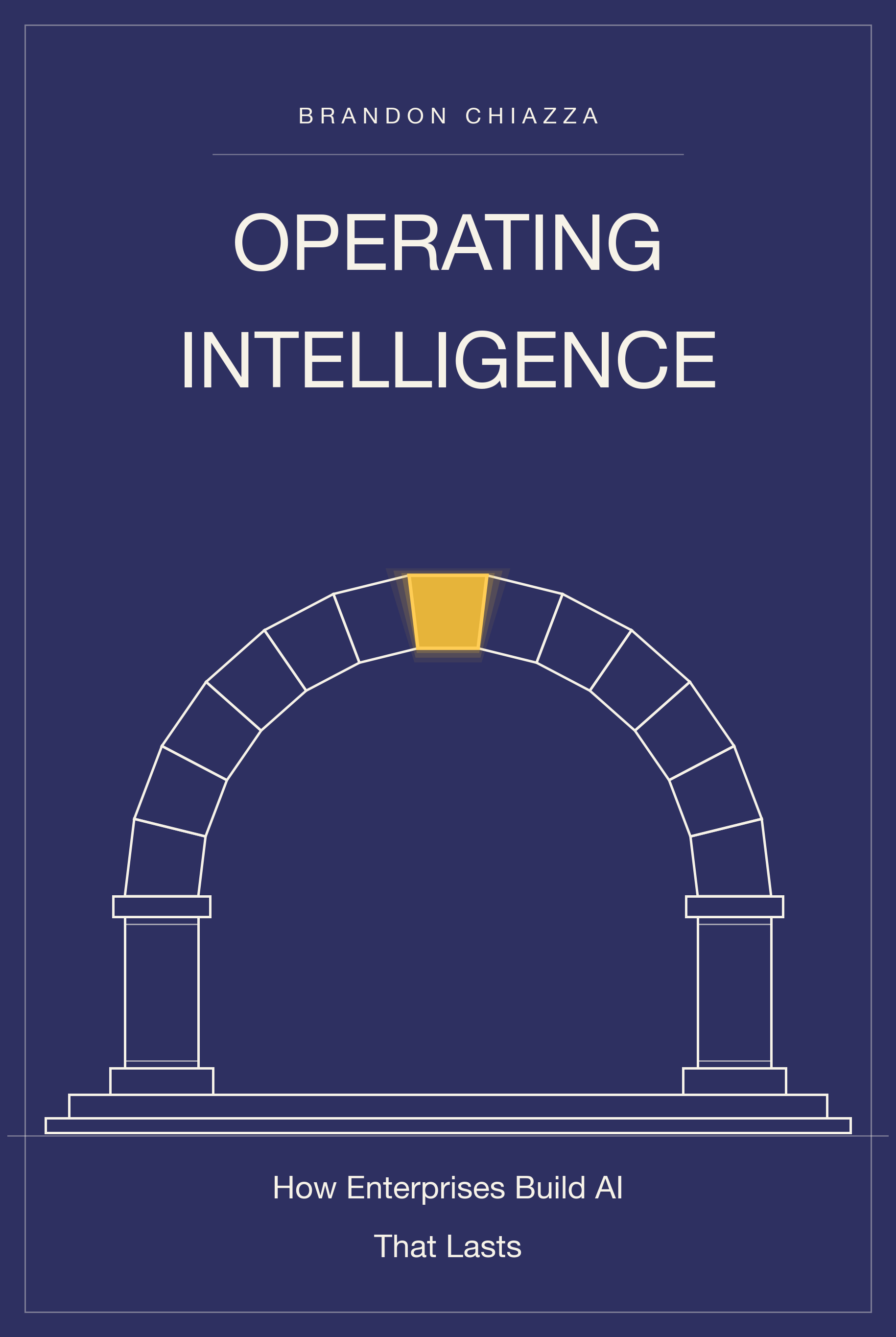
Operating Intelligence: How Enterprises Build AI That Lasts is the 650-page argument the Twelve Laws compress. It develops the context layer as enterprise infrastructure, proof of value as the unit of AI investment, and operating-model redesign as the price of getting AI value out of the program.
Available on Amazon in paperback and Kindle. An Executive Edition (~250 pages) carries the strategic spine for time-poor leaders. Pre-order the Kindle edition now; paperback ships Summer 2026.
CEO of Modali Consulting and faculty at the Cornell Brooks School of Public Policy. Former CTO at the New York City Mayor's Office of Contract Services. Holds AI-related patents in cost modeling and procurement. Authored the MyCity, MyAI public-policy case study at Cornell — the public-sector AI deployment that frames the governance argument across Chapters 6, 16, and 19 of the book.